Appearance
GPS-IMU Fusion
Problem Statement
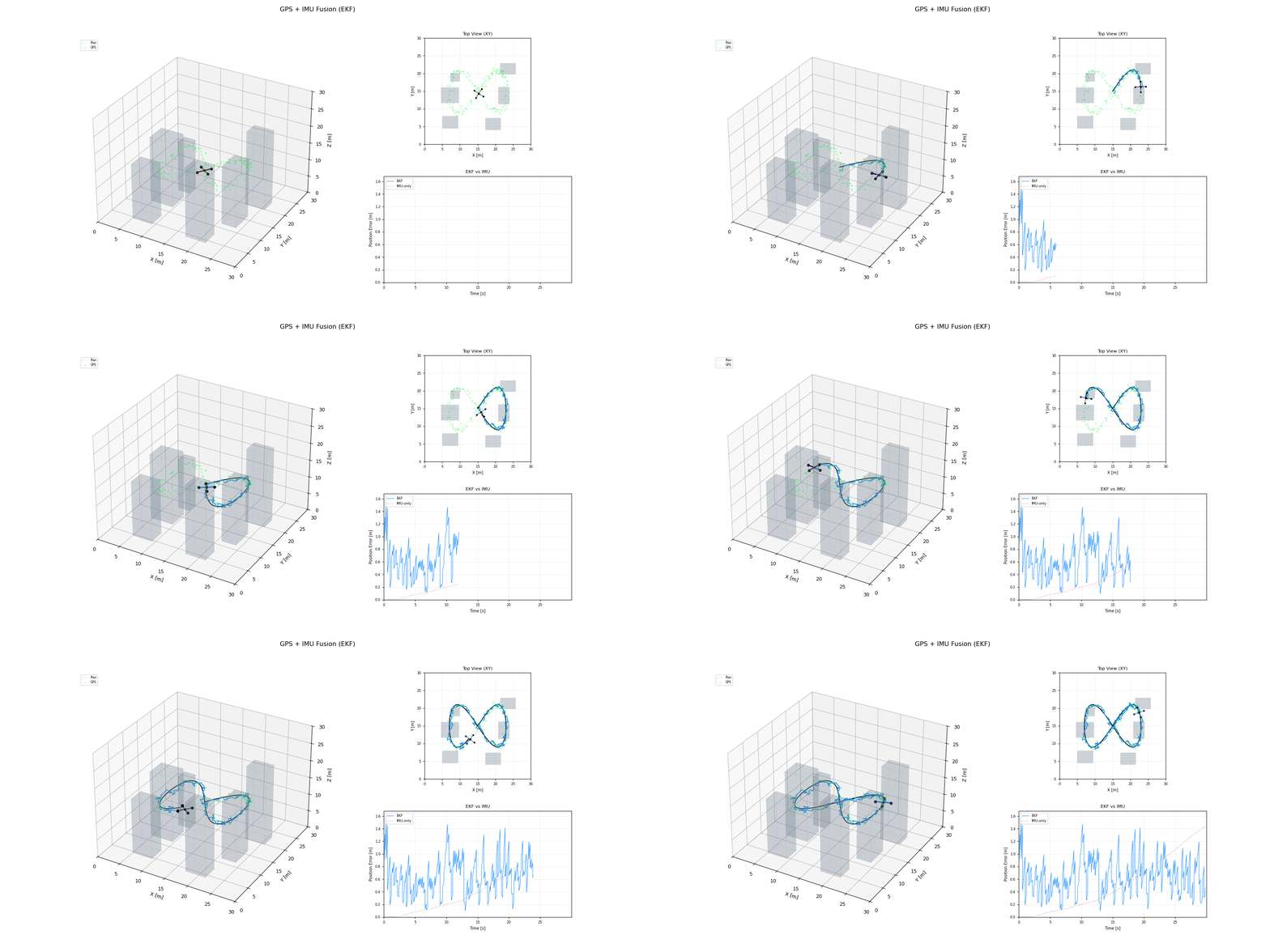
IMU integration is high-rate but drifts; GPS is globally referenced but low-rate and noisy. GPS-IMU fusion combines both into a single estimate that remains smooth, drift-limited, and real-time.
Model and Formulation
The fused estimator uses IMU-driven prediction and GPS correction:
$$ \hat{x}{k|k-1} = f(\hat{x}, u^{imu}_k) $$
$$ \hat{x}{k|k} = \hat{x} + K_k\left(z^{gps}k - h(\hat{x})\right) $$
The asynchronous rate structure is critical: f runs at IMU rate, update only when GPS messages arrive.
Algorithm Procedure
- Integrate IMU acceleration and angular rate at high frequency.
- Propagate covariance with process model and bias noise.
- On each GPS arrival, compute innovation and perform correction.
- Publish fused state for path tracking and planning.
Tuning Guidance
- Keep GPS
Rrealistic; over-trusting GPS causes noisy position estimates. - Include IMU bias states whenever drift is non-negligible.
- Use timestamp-consistent interpolation/extrapolation for sensor alignment.
Failure Modes and Diagnostics
- Time synchronization error can appear as oscillatory position correction.
- GPS dropouts cause rapid uncertainty growth if process noise is under-modeled.
- Bias unobservability yields slowly diverging velocity/attitude estimates.
Implementation and Execution
bash
python -m uav_sim.simulations.estimation.gps_imu_fusionEvidence
References
- Groves, Principles of GNSS, Inertial, and Multisensor Integrated Navigation Systems
- Maybeck, Stochastic Models, Estimation, and Control