Appearance
Unscented Kalman Filter (UKF)
Problem Statement
For strongly nonlinear dynamics, first-order Jacobian linearization can degrade EKF accuracy. The UKF uses deterministic sigma-point propagation to capture higher-order effects without symbolic Jacobians.
Model and Formulation
Given state mean \mu and covariance P, construct 2n+1 sigma points:
$$ \chi_0 = \mu,\quad \chi_i = \mu \pm \left(\sqrt{(n+\lambda)P}\right)_i $$
Propagate each point through nonlinear models, then recover moments:
$$ \hat{\mu} = \sum_i W_i^{(m)}\chi_i,\quad \hat{P} = \sum_i W_i^{(c)}(\chi_i-\hat{\mu})(\chi_i-\hat{\mu})^\top + Q $$
Algorithm Procedure
- Generate sigma points using
(\alpha,\beta,\kappa)scaling. - Propagate points through process model for prediction.
- Project predicted points into measurement space.
- Compute gain from cross-covariance and update posterior state.
Tuning Guidance
- Use small
\alpha(1e-3to1e-1) for local spread control. - Set
\beta=2for approximately Gaussian priors. - Increase process noise if sigma clouds collapse under model mismatch.
Failure Modes and Diagnostics
- Poor scaling parameters can produce non-positive definite covariance.
- Non-Gaussian heavy-tailed noise can still break Gaussian-moment assumptions.
- Monitor covariance eigenvalues to detect numerical instability.
Implementation and Execution
bash
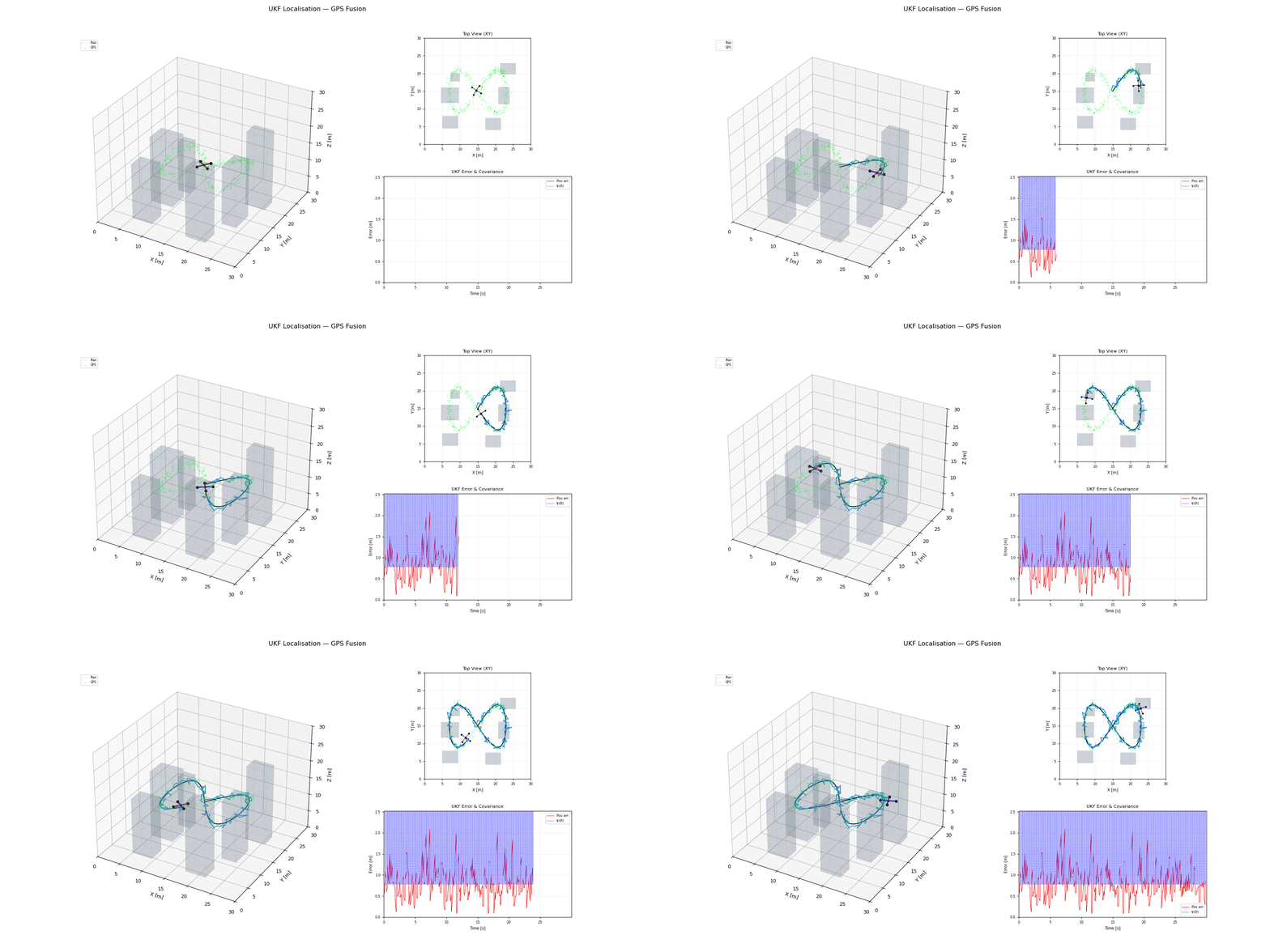
python -m uav_sim.simulations.estimation.ukfEvidence
References
- Wan and Van der Merwe, The Unscented Kalman Filter for Nonlinear Estimation (2000)
- Julier and Uhlmann, Unscented Filtering and Nonlinear Estimation, Proceedings of the IEEE (2004)