Appearance
Particle Filter
Problem Statement
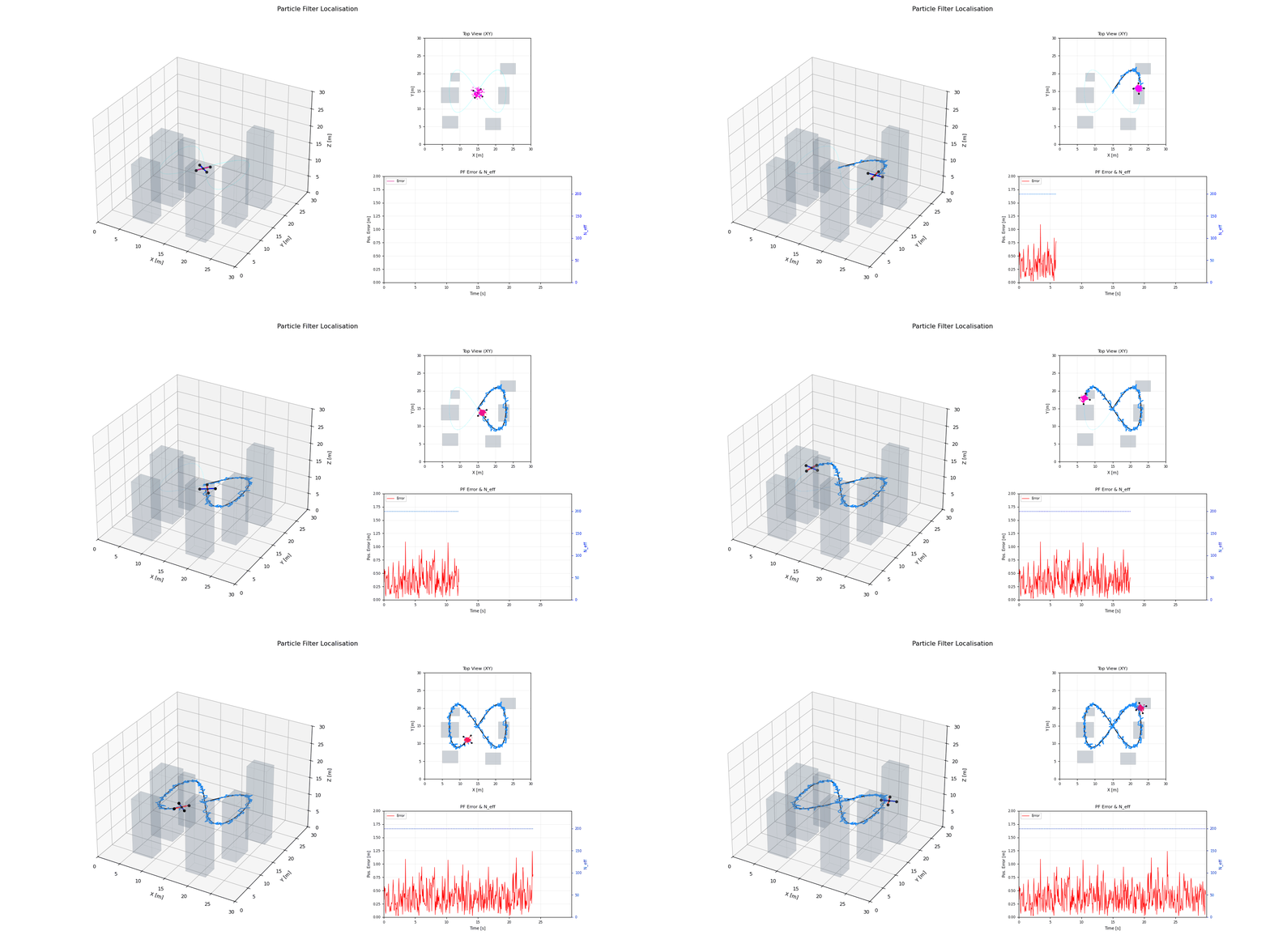
When posterior distributions are multi-modal or strongly non-Gaussian, Kalman-family filters become brittle. Particle filters approximate the full posterior with weighted samples and remain effective in nonlinear, non-Gaussian settings.
Model and Formulation
The posterior is approximated by particles:
$$ p(x_k|z_{1:k}) \approx \sum_{i=1}^{N} w_k^{(i)}\delta\left(x_k - x_k^{(i)}\right) $$
Weights are updated from measurement likelihood:
$$ w_k^{(i)} \propto w_{k-1}^{(i)}p(z_k|x_k^{(i)}) $$
Resampling is triggered by effective sample size:
$$ N_{eff} = \frac{1}{\sum_i (w_k^{(i)})^2} $$
Algorithm Procedure
- Sample particles from transition model.
- Evaluate measurement likelihood for each particle.
- Normalize weights and compute
N_eff. - Resample when degeneracy threshold is crossed.
Tuning Guidance
- Increase particle count for higher-dimensional states.
- Match proposal noise to platform maneuver envelope.
- Use stratified/systematic resampling to reduce variance.
Failure Modes and Diagnostics
- Particle impoverishment occurs with frequent resampling and narrow proposals.
- Sparse particle sets miss low-probability but valid hypotheses.
- Computational load scales with particle count and measurement complexity.
Implementation and Execution
bash
python -m uav_sim.simulations.estimation.particle_filterEvidence
References
- Arulampalam et al., A Tutorial on Particle Filters for Online Nonlinear/Non-Gaussian Bayesian Tracking (2002)
- Doucet and Johansen, A Tutorial on Particle Filtering and Smoothing (2009)