Appearance
Minimum-Snap Trajectory
Problem Statement
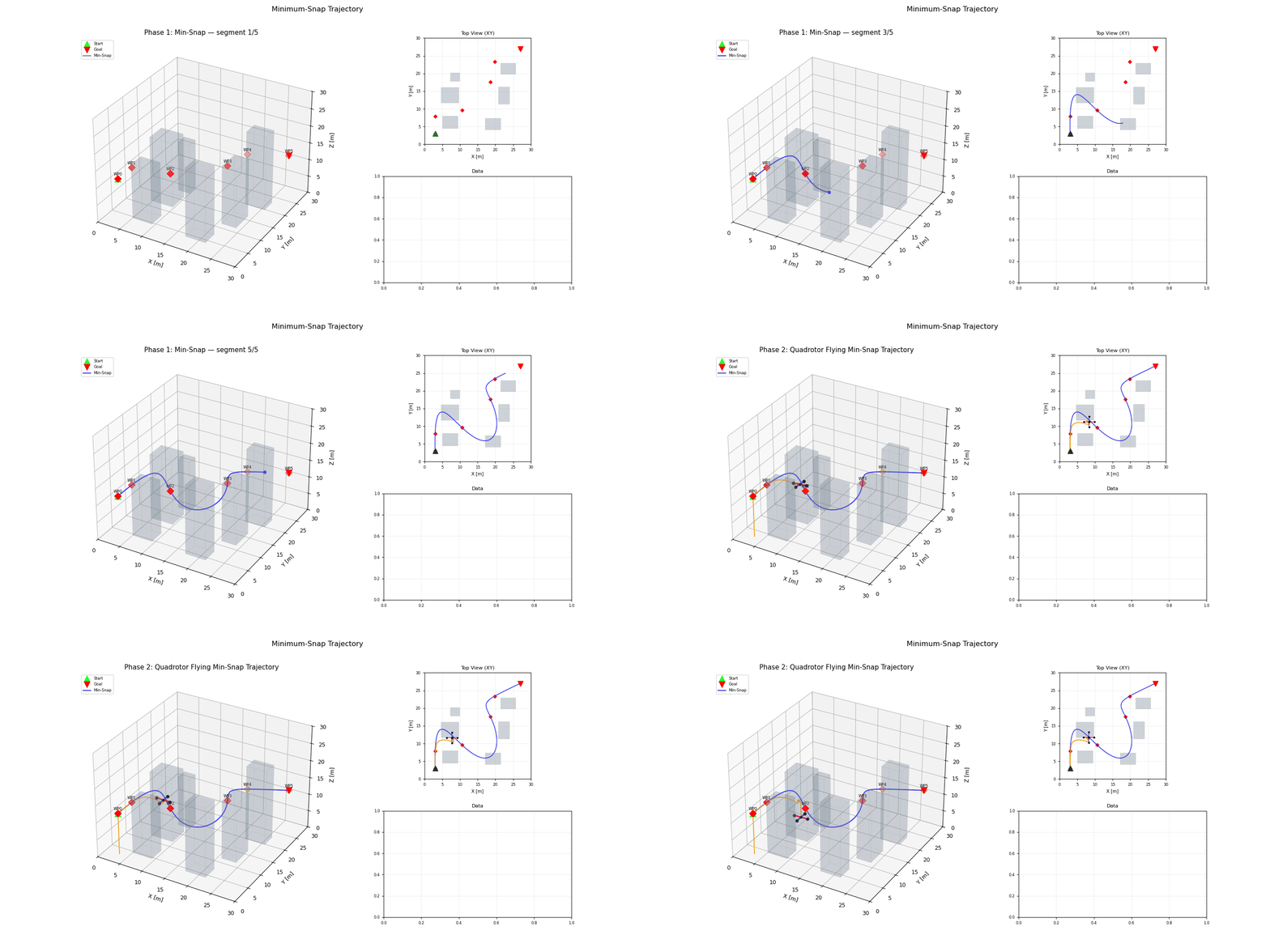
Waypoint-only paths are not directly flyable because they ignore high-order dynamic smoothness. Minimum-snap planning computes polynomial trajectories that reduce aggressive jerk/snap behavior and improve tracking performance.
Model and Formulation
Each segment is represented by a polynomial:
$$ p(t) = \sum_{i=0}^{n} c_i t^i $$
The optimization minimizes integrated snap:
$$ J = \int_{0}^{T}\left|\frac{d^4p(t)}{dt^4}\right|^2dt $$
subject to waypoint and continuity constraints for position, velocity, acceleration, and jerk.
Algorithm Procedure
- Allocate segment times across waypoints.
- Build quadratic cost matrix for snap objective.
- Apply boundary and continuity equality constraints.
- Solve constrained QP for polynomial coefficients.
Tuning Guidance
- Time allocation dominates smoothness-quality trade-offs.
- Enforce corridor constraints for cluttered environments.
- Increase continuity order for aggressive maneuvers with tight tracking budgets.
Failure Modes and Diagnostics
- Unrealistic segment times create numerically stiff trajectories.
- Sparse waypoints can violate obstacle-clearance assumptions.
- Overly smooth trajectories may become too conservative for time-critical tasks.
Implementation and Execution
bash
python -m uav_sim.simulations.trajectory_planning.min_snapEvidence
References
- Mellinger and Kumar, Minimum Snap Trajectory Generation and Control for Quadrotors (2011)
- Richter, Bry, Roy, Polynomial Trajectory Planning for Aggressive Quadrotor Flight (2016)