Appearance
Quintic Polynomial Trajectory
Problem Statement
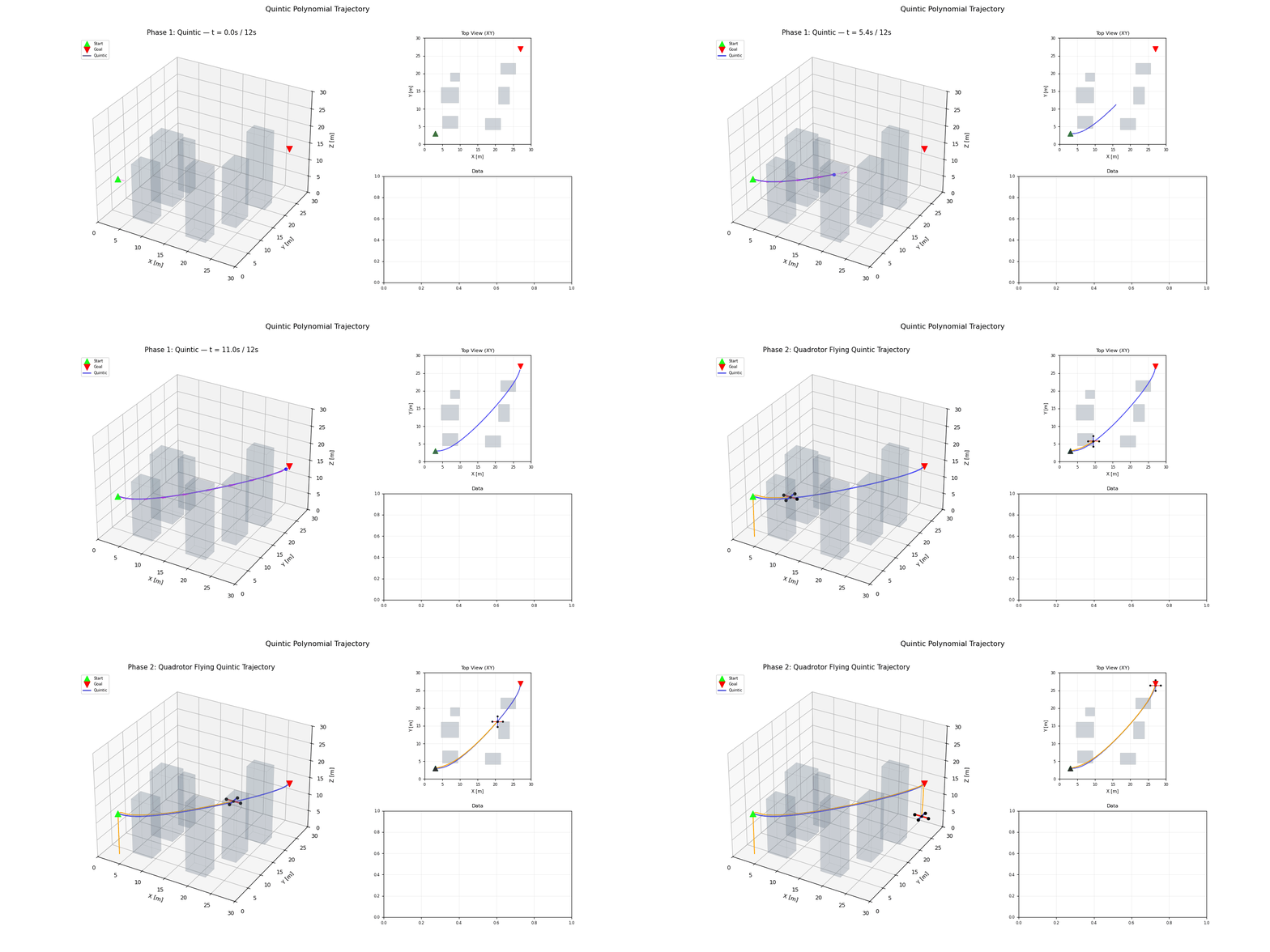
Quintic trajectories are a standard choice for smooth motion generation with guaranteed continuity up to acceleration. They provide practical C2 motion profiles for UAV transitions and corridor following.
Model and Formulation
Use a fifth-order polynomial:
$$ p(t) = a_0 + a_1 t + a_2 t^2 + a_3 t^3 + a_4 t^4 + a_5 t^5 $$
Boundary conditions at initial and final times constrain position, velocity, and acceleration:
$$ p(0),\dot{p}(0),\ddot{p}(0),p(T),\dot{p}(T),\ddot{p}(T) $$
forming a linear system for a_0..a_5.
Algorithm Procedure
- Select endpoint state and maneuver duration
T. - Construct 6x6 boundary-condition system.
- Solve coefficients and evaluate trajectory over time.
- Feed resulting reference to the tracking controller.
Tuning Guidance
- Duration
Tcontrols aggressiveness directly. - Use axis-specific duration scaling for asymmetric constraints.
- Validate peak acceleration and jerk against actuator limits.
Failure Modes and Diagnostics
- Very small
Tvalues produce infeasible accelerations. - Discontinuous waypoint chaining can violate C2 assumptions.
- Numerical conditioning worsens when time scales vary widely.
Implementation and Execution
bash
python -m uav_sim.simulations.trajectory_planning.quintic_polynomial_demoEvidence
References
- Werling et al., Optimal Trajectory Generation for Dynamic Street Scenarios in a Frenet Frame (2010)
- Kelly and Nagy, Reactive Nonholonomic Trajectory Generation via Parametric Optimal Control